Luxury travel feels effortless when everything goes right. The first-class seat is confirmed, the five-star hotel suite is waiting, the private airport transfer is arranged, and the dinner reservation has the perfect view. But premium trips also come with premium risk. A cancelled flight, sudden illness, lost luggage, missed connection, hotel disruption, or family emergency can turn a dream itinerary into a very expensive problem. That is why luxury travel insurance for premium hotel and flight bookings is not just a small add-on at checkout. For high-value travel, it can be an important financial protection tool.
Luxury travelers usually spend more before the trip even starts. They may book non-refundable business class flights, first class airline seats, private villas, honeymoon suites, luxury safari lodges, cruise cabins, private transfers, spa packages, or exclusive tours. When those bookings are prepaid and non-refundable, the financial exposure becomes serious. Standard travel insurance may be enough for a simple weekend getaway, but expensive trips often need stronger coverage, higher limits, and careful policy review.
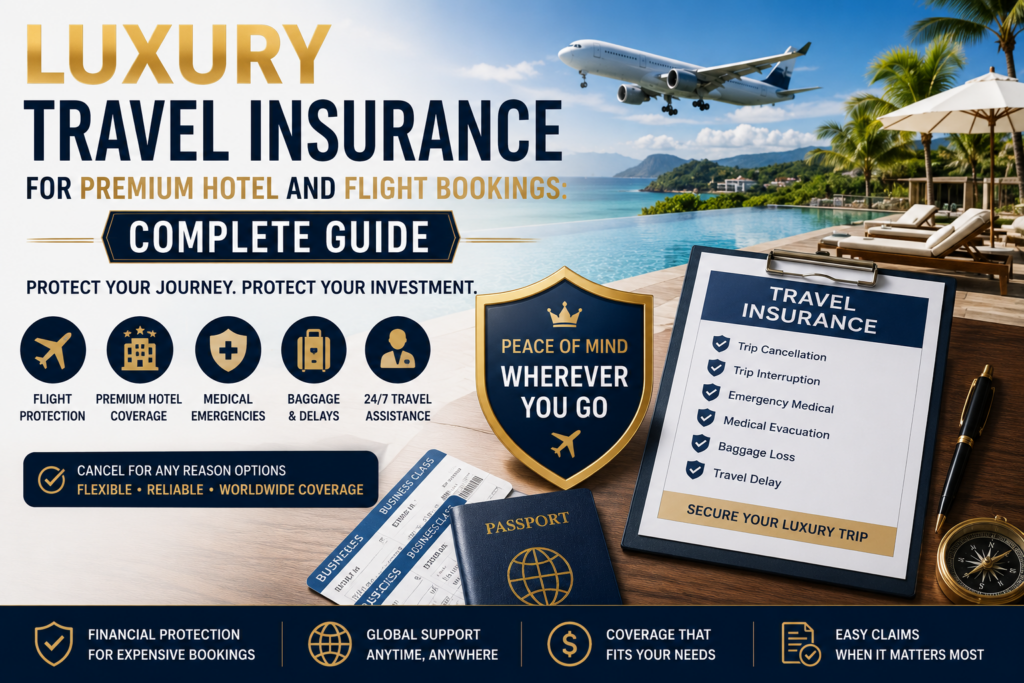
The goal of premium travel insurance is simple: protect the money you already invested and reduce the stress of unexpected travel problems. A strong policy can cover trip cancellation, trip interruption, emergency medical costs, medical evacuation, baggage loss, travel delays, missed connections, and sometimes broader cancellation flexibility through Cancel For Any Reason, also called CFAR. However, coverage varies widely by insurer, policy type, destination, traveler age, trip cost, and exclusions. That is why luxury travelers should not buy travel insurance blindly.
Why Luxury Travelers Need Better Travel Insurance
Luxury travel creates a different risk profile from budget travel. If you book a cheap economy flight and a refundable hotel, your potential loss may be small. But if you book first class flights, private airport transfers, a non-refundable luxury resort, and a prepaid multi-day experience, the amount at risk can become large very quickly. A single illness, travel disruption, or family emergency could affect thousands or even tens of thousands of dollars in prepaid travel expenses.
A good travel insurance policy can help reimburse non-refundable costs when a covered reason forces you to cancel or interrupt your trip. GMS describes trip cancellation and interruption insurance as coverage designed to reimburse non-refundable expenses if a trip is cancelled before it begins or cut short after departure for a covered reason. That definition is especially important for luxury travelers because many premium hotels, villas, private tours, and airfare bookings come with strict cancellation windows.
Luxury travelers also need to think beyond cancellation. Medical emergencies abroad can be expensive, and regular health insurance may not offer enough protection outside your home country. The CDC notes that specialized insurance policies may be especially beneficial for travelers with preexisting medical conditions, pregnant travelers, travelers over age 65, and people spending extended time abroad. For premium travelers visiting remote islands, safari destinations, ski resorts, cruise routes, or medical-access-limited regions, this becomes even more important.
What Luxury Travel Insurance Usually Covers
Luxury travel insurance usually includes several major categories of protection. The most important are trip cancellation, trip interruption, emergency medical expenses, emergency evacuation, baggage loss or delay, travel delay, missed connection, and sometimes rental car coverage. These benefits sound simple, but the details matter. Every policy has limits, exclusions, documentation requirements, and covered reasons.
Trip cancellation coverage usually applies before departure. If you must cancel for a covered reason, the policy may reimburse prepaid and non-refundable travel costs. Covered reasons often include serious illness, injury, death of a family member, severe weather, jury duty, job loss, or other listed events, depending on the policy. Allianz explains that covered reasons matter because the cancellation event must meet the policy’s definitions; for example, some illness-related cancellations may require hospitalization or a life-threatening condition for a family member.
Trip interruption coverage applies after the trip begins. This can be important for premium hotel and flight bookings because an interrupted trip can create multiple costs at once. You may lose unused hotel nights, need to book last-minute flights home, pay change fees, or arrange extra accommodation during disruption. For luxury travelers, interruption protection can be even more valuable than cancellation coverage because last-minute premium travel expenses can be extremely high.
Emergency medical coverage helps pay for eligible medical care during the trip. Emergency medical evacuation coverage can help transport you to an appropriate medical facility or back home when medically necessary. Consumer Reports cites guidance that international travelers should consider at least $50,000 in emergency medical coverage and $100,000 in medical evacuation coverage, with higher limits suggested for cruises or remote destinations. For luxury travelers booking remote resorts, private islands, expedition cruises, or safari lodges, higher evacuation limits may be a smart choice.
Why Premium Hotel Bookings Need Insurance
Premium hotels often have strict cancellation rules, especially during high-demand travel periods. Luxury resorts, island villas, safari lodges, private residences, ski chalets, and holiday-season hotels may require large deposits or full prepayment. Some properties become non-refundable weeks or months before arrival. If your plans change unexpectedly, the hotel may not be obligated to refund your booking unless its cancellation policy allows it.
This is where travel insurance for expensive hotels becomes valuable. If your cancellation reason is covered, trip cancellation insurance may reimburse the non-refundable hotel amount. This can include luxury resort stays, honeymoon suites, private villas, and prepaid hotel packages. The key phrase is “covered reason.” Travel insurance is not a magic refund button unless you buy a broader option like CFAR, and even CFAR has rules.
Luxury hotel travelers should also insure the full prepaid trip cost, not only the flight. If you insure only the airfare but forget the hotel deposit, the hotel loss may not be fully protected. This matters for travelers building complicated luxury itineraries with multiple hotels, transfers, dining deposits, private tours, and wellness packages. Each non-refundable component should be included when calculating insured trip cost.
Why First Class and Business Class Flights Need Protection
Premium flights can be one of the biggest costs in a luxury trip. First class and business class fares may be partially refundable, fully refundable, or highly restricted depending on the fare type. Many travelers assume expensive tickets are always flexible, but that is not always true. A discounted business class fare may have cancellation penalties, refund restrictions, upgrade limits, or rebooking rules that are less generous than expected.
Travel insurance for premium flights can help protect non-refundable airfare if you must cancel for a covered reason. It can also help with trip interruption, missed connections, travel delays, baggage delay, and additional transportation expenses depending on the policy. AAA’s travel insurance guide explains that good travel insurance can cover issues such as flight delays, lost baggage, medical emergencies, and expensive evacuations, which are exactly the problems premium travelers want to avoid managing alone.
Premium flight travelers should also check whether they already have protection through the airline, credit card, or booking platform. Some premium credit cards include trip delay, baggage, rental car, or cancellation benefits, but these benefits have limits and activation requirements. Consumer NZ notes that credit card travel insurance may need to be activated by paying for some of the trip with the card, and policies may include journey-length limits, eligibility checks, and age limits.
Standard Travel Insurance vs Luxury Travel Insurance
Standard travel insurance can work well for ordinary trips, but luxury travel often needs higher coverage limits and more flexible benefits. A basic policy may not cover the full value of a first class flight, a private villa, or an extended five-star itinerary. It may also have lower medical limits, lower baggage limits, or less generous delay coverage. For a premium traveler, those limits can create gaps.
Luxury travel insurance usually offers stronger protection for expensive prepaid travel costs. It may include higher trip cancellation limits, higher emergency medical coverage, higher evacuation coverage, concierge assistance, broader baggage benefits, and optional CFAR upgrades. Some premium policies also support adventure activities, cruise travel, business equipment, or multi-destination itineraries, though these benefits vary widely.
The most important difference is not the name of the policy. It is the benefit schedule. Luxury travelers should compare coverage limits line by line. A policy with a fancy name but low limits may be weaker than a less glamorous plan with better benefits. The best luxury travel insurance for premium hotel and flight bookings is the policy that matches the actual value and risk of your trip.
Key Coverage Types to Compare
| Coverage Type | Why It Matters for Luxury Travel | What to Check |
|---|---|---|
| Trip Cancellation | Protects prepaid non-refundable costs before departure | Covered reasons, maximum trip cost, documentation rules |
| Trip Interruption | Helps when the trip is cut short after departure | Reimbursement percentage, return flight costs, unused hotel nights |
| Emergency Medical | Covers eligible medical care abroad | Coverage limit, exclusions, preexisting condition rules |
| Medical Evacuation | Helps arrange transport to proper medical care | Evacuation limit, remote destination coverage, approval process |
| Travel Delay | Helps with meals, hotels, and essentials during delays | Required delay hours, daily limits, maximum benefit |
| Baggage Loss or Delay | Useful for luxury clothing, formalwear, and essentials | Per-item limits, valuables exclusions, receipts required |
| Missed Connection | Important for multi-leg premium itineraries | Minimum delay period, covered transport types |
| CFAR | Adds flexible cancellation protection | Purchase deadline, reimbursement percentage, cancellation deadline |
Cancel For Any Reason Coverage for Luxury Trips
Cancel For Any Reason coverage is one of the most important upgrades for luxury travelers who want more flexibility. Standard trip cancellation insurance only applies to listed covered reasons. CFAR can allow partial reimbursement when you cancel for a reason that is not otherwise covered. IMG describes CFAR as a benefit that lets travelers receive partial reimbursement when cancelling for a reason not otherwise covered under the plan.
CFAR is especially useful for expensive luxury trips because life can change in ways that standard insurance does not cover. You may feel uncomfortable traveling because of personal concerns, business obligations may shift, a relationship situation may change, or you may simply decide the timing is no longer right. Standard insurance may not help in those cases. CFAR may offer partial reimbursement if you follow the rules.
However, CFAR is not unlimited. Condé Nast Traveler’s CFAR guide notes that CFAR generally must be purchased soon after the first trip payment, often within a limited window, and usually requires cancellation at least 48 hours before departure. It also often reimburses only part of the trip cost, commonly around 50% to 75%, depending on the plan.
For luxury travelers, CFAR is worth considering when the trip is expensive, highly prepaid, emotionally important, or difficult to reschedule. Honeymoons, anniversary trips, private island stays, destination weddings, first class journeys, and major family vacations are good examples. The higher the prepaid non-refundable cost, the more valuable flexibility becomes.
How Much Coverage Do Premium Travelers Need?
The right coverage amount depends on the trip cost, destination, traveler health, itinerary complexity, and risk tolerance. At a minimum, luxury travelers should insure all prepaid and non-refundable costs they want protected. This includes flights, hotels, cruises, tours, transfers, villas, private guides, and other prepaid travel arrangements. If you leave a major expense out of the insured trip cost, you may not be fully reimbursed if something goes wrong.
Medical and evacuation limits deserve special attention. Consumer Reports cites recommended minimums of $50,000 for emergency medical coverage and $100,000 for medical evacuation for international trips, with higher limits for cruises and remote destinations. Luxury travelers visiting the Maldives, Seychelles, safari regions, polar routes, private islands, remote ski areas, or yacht destinations may want stronger evacuation protection because transport to suitable care can be extremely expensive.
Travelers should also consider baggage and personal effects limits. Luxury luggage, designer clothing, jewelry, watches, cameras, laptops, and formalwear may exceed standard baggage limits. Many policies have per-item limits and exclusions for high-value goods. If you travel with expensive items, check whether separate valuable-item insurance or homeowner coverage is more appropriate.
What Luxury Travel Insurance May Not Cover
Travel insurance exclusions are just as important as benefits. Many policies exclude predictable events, known issues, reckless behavior, intoxication-related incidents, professional sports, some adventure activities, war, certain epidemics, government restrictions, or travel against official advice. Policies may also exclude preexisting medical conditions unless you qualify for a waiver. This is why reading the policy wording matters.
Luxury travelers should be careful with assumptions. A delayed private transfer may not be covered unless it causes a covered travel disruption under the policy. A bad hotel experience may not be covered unless it fits a specific benefit. A change of mind is usually not covered unless you have CFAR and meet the requirements. A luxury hotel refusing to refund a deposit does not automatically mean insurance will reimburse it.
Travelers should also understand supplier default coverage. If an airline, hotel, cruise company, or tour operator fails financially, coverage depends on the policy. Some plans include supplier default protection, while others exclude it or limit it to specific suppliers. For expensive trips, this detail can matter.
Travel Insurance and Credit Card Benefits
Premium credit cards can offer valuable travel protection, but they should not be treated as automatic full replacement for a comprehensive policy. Credit card coverage may include trip delay, baggage delay, lost luggage, rental car protection, emergency assistance, or trip cancellation benefits. However, coverage often depends on paying for the trip with that card and meeting specific activation requirements.
Consumer NZ highlights that credit card travel insurance may require activation and may have limits on journey length, age, and eligibility. That means travelers should check the card’s insurance booklet before relying on it for a luxury trip.
For premium hotel and flight bookings, the best approach is to compare your credit card benefits against a standalone travel insurance policy. Look at trip cancellation limits, medical coverage, evacuation coverage, baggage limits, exclusions, and claim procedures. If your card has strong delay coverage but weak medical evacuation coverage, you may still need separate insurance. If your card covers only part of the trip cost, a standalone policy may be safer.
When to Buy Luxury Travel Insurance
The best time to buy travel insurance is soon after making the first trip payment. This is especially true if you want time-sensitive benefits such as CFAR or a preexisting medical condition waiver. Many policies require purchase within a specific number of days after the first deposit to qualify for these upgrades. Waiting too long can reduce your options.
Buying early also protects the period before departure. If you book a luxury trip six months in advance but wait until the week before departure to buy insurance, you may miss months of cancellation protection. If something happens before you buy the policy, it is usually not covered. Travel insurance is designed for unexpected events, not problems you already know about.
Luxury travelers should also update the policy when adding new trip costs. If you book flights first, then later add hotels, tours, private transfers, or excursions, update the insured trip cost as required by the policy. This helps keep coverage aligned with the true value of the trip.
How to Choose the Best Luxury Travel Insurance Policy
Start by calculating the total prepaid and non-refundable trip cost. Then identify your biggest risks. Are you worried about cancellation? Medical care abroad? Evacuation from a remote area? Lost luggage? Flight disruption? Business schedule changes? The best policy is the one that matches your real concerns.
Next, compare policies by benefits, not only price. InsureMyTrip’s 2026 comparison guide emphasizes that travel insurance plans vary widely in price and protection, which makes comparing coverage important. A cheaper policy may look attractive, but it may also have lower limits or exclusions that make it unsuitable for an expensive luxury itinerary.
Finally, read the claim requirements. You may need medical documentation, airline delay proof, hotel cancellation invoices, receipts, police reports, baggage reports, or written confirmation from travel suppliers. Keep digital copies of bookings, payment receipts, cancellation policies, and communication with airlines or hotels. A strong policy is only useful if you can support the claim properly.
Luxury Travel Insurance Checklist
Before buying a policy, premium travelers should confirm the following details:
| Question | Why It Matters |
|---|---|
| Does the policy cover the full prepaid non-refundable trip cost? | Premium hotels and flights can exceed basic policy limits. |
| Are first class flights and luxury hotels included? | High-value bookings must fit within coverage limits. |
| Is emergency medical coverage high enough? | Medical care abroad can be expensive. |
| Is medical evacuation coverage strong enough? | Remote luxury destinations may require costly transport. |
| Is CFAR available? | Useful for flexible cancellation protection. |
| Are preexisting conditions covered or waived? | Important for older travelers or known health concerns. |
| Are baggage limits high enough? | Luxury luggage and valuables may exceed standard limits. |
| Does credit card coverage already apply? | Avoid duplicate coverage but check for gaps. |
| What documents are needed for claims? | Claims depend on proper evidence. |
| When must the policy be purchased? | Some benefits are time-sensitive. |
Common Mistakes to Avoid
The first mistake is buying the cheapest policy without checking limits. Luxury trips need coverage that matches the value of the bookings. A low-cost policy may not reimburse enough if a first class flight, villa deposit, or luxury cruise is cancelled. Price matters, but protection matters more.
The second mistake is assuming every reason for cancellation is covered. Standard trip cancellation coverage only applies to listed reasons. If you want broader flexibility, look at CFAR. Even then, follow the deadline and reimbursement rules carefully.
The third mistake is forgetting to insure all trip components. Luxury travelers often book flights, hotels, transfers, tours, and dining experiences separately. If only the flight is insured, the hotel may be exposed. Keep a running list of prepaid non-refundable expenses and update coverage when needed.
The fourth mistake is ignoring medical evacuation. This is especially risky for remote destinations. A luxury resort can feel safe and beautiful, but medical infrastructure may be far away. A strong evacuation benefit can be critical when distance becomes a problem.
Conclusion
Luxury travel insurance for premium hotel and flight bookings is not about expecting something to go wrong. It is about protecting a high-value trip from uncertainty. When travelers spend serious money on first class flights, five-star hotels, private villas, cruises, safaris, honeymoon packages, and exclusive experiences, the financial risk becomes too large to ignore. A strong policy can protect prepaid costs, support medical emergencies, cover disruptions, and reduce stress when plans change unexpectedly.
The best premium travel insurance policy is the one that fits the actual trip. Look closely at cancellation coverage, interruption benefits, emergency medical limits, evacuation protection, baggage rules, CFAR availability, credit card overlaps, and claim documentation. Buy early, insure the full trip cost, and read the exclusions before you travel. Luxury travel should feel smooth, comfortable, and memorable. The right insurance helps keep it that way, even when the unexpected arrives.
FAQs
1. What is luxury travel insurance?
Luxury travel insurance is travel protection designed for expensive trips that include premium flights, luxury hotels, private villas, cruises, safaris, or high-value prepaid experiences. It usually offers higher coverage limits and broader benefits than basic travel insurance.
2. Does travel insurance cover first class flights?
Yes, travel insurance can cover first class flights if the airfare is prepaid, non-refundable, and included in the insured trip cost. Coverage depends on the policy, cancellation reason, fare rules, and documentation.
3. Does travel insurance cover luxury hotel bookings?
Travel insurance can cover non-refundable luxury hotel bookings if the trip is cancelled or interrupted for a covered reason. Travelers should include hotel deposits and prepaid stays when calculating the insured trip cost.
4. Is Cancel For Any Reason worth it for luxury travel?
Cancel For Any Reason can be worth it for expensive luxury trips because it provides broader cancellation flexibility. It usually costs more, must be purchased soon after the first trip payment, and often reimburses only part of the trip cost.
5. When should I buy travel insurance for a premium trip?
Buy travel insurance soon after making the first trip payment. This helps protect the pre-departure period and may qualify you for time-sensitive benefits such as CFAR or preexisting condition waivers.